
Choosing between a gunite vs vinyl pool is the first real decision most Pennsylvania homeowners face, and it shapes everything that follows: the budget, the build schedule, the shape of the pool, and what ownership costs look like ten years from now. Neither option is universally better. They are two different construction methods with different strengths.
This guide breaks down how each type is built, what each costs over time, how they handle Pennsylvania winters, and how to evaluate pool builders in Pennsylvania before you sign anything. By the end you should know which construction method fits your property and your plans, and what questions to ask on your first site visit.
Key Takeaways
- The gunite vs vinyl pool decision is driven by current pool pricing in Pennsylvania, lifespan, and design freedom.
- Gunite is a steel-and-concrete shell, allowing custom shapes, depths, and integrated features.
- Vinyl liner pools install faster and cost less upfront, but liners are replaced periodically.
- Pennsylvania freeze-thaw cycles make proper winterization critical for both pool types.
- Always verify your pool builder’s credentials before signing with any builder.
- Request a written scope covering excavation, decking, equipment, and startup, not just a base price.
How Each Pool Type Is Actually Built
The construction method is the entire difference. Understanding it makes every other comparison easier to follow.
Gunite Construction
A gunite pool starts as an excavated hole reinforced with a steel rebar cage. A pneumatic hose sprays a dry mix of cement and sand, hydrated at the nozzle, onto that steel framework. The result is a monolithic concrete shell that follows whatever shape the rebar was bent into.
That shell then cures for several weeks before receiving an interior finish: plaster, quartz aggregate, or pebble. The finish is what you see and feel, and it is replaced periodically over the pool’s life while the shell itself remains.
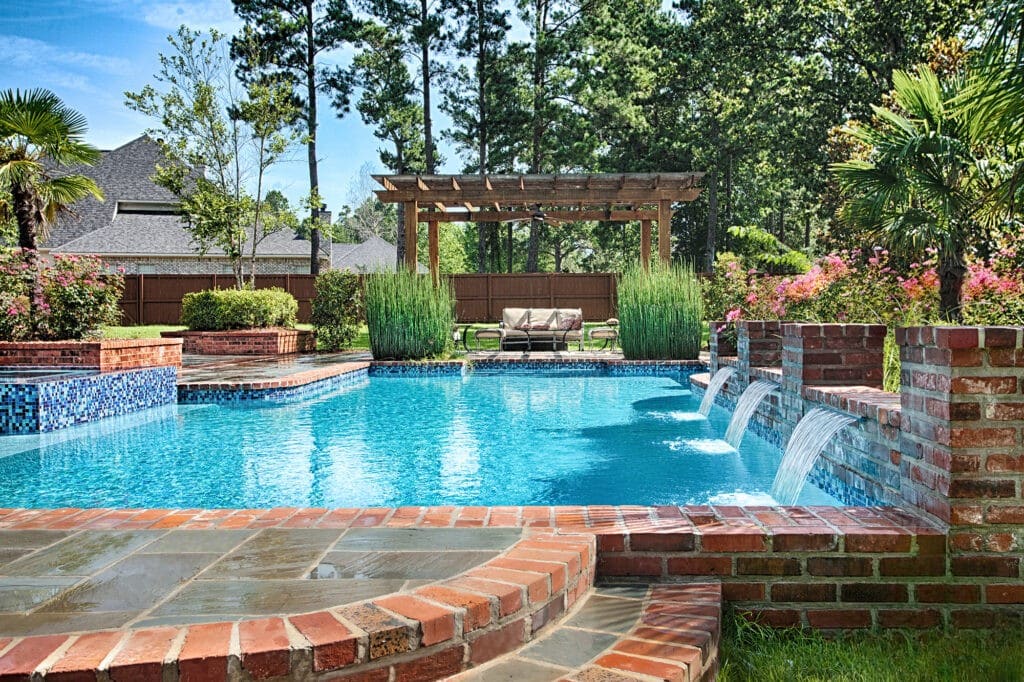
Because the shell is formed on site, gunite places almost no limits on shape, depth, or built-in features. Tanning ledges, vanishing edges, attached spas, and beach entries all become structural parts of the same shell.
Vinyl Liner Construction
A vinyl liner pool uses a prefabricated wall system, typically polymer or galvanized steel panels, set on a concrete footing around an excavated hole. The floor is troweled from a vermiculite or grout mix, and a custom-fitted vinyl membrane is stretched across the whole interior and locked into a track at the top of the walls.
Water pressure holds the liner in place. The wall panels and floor provide structure, but the liner is what actually contains the water, which is why liner condition matters so much to ownership costs.
Vinyl pools are built from manufactured components, so the shapes are more constrained. Custom freeform designs are possible with some manufacturers but come at a premium and still cannot match gunite’s flexibility.
Comparison Table: Gunite vs Vinyl at a Glance
| Factor | Gunite Pool | Vinyl Liner Pool |
|---|---|---|
| Upfront cost | Higher | Lower |
| Typical build time | Longer, often several months | Shorter, often several weeks |
| Shell lifespan | Decades with resurfacing | Decades for walls, liner replaced periodically |
| Recurring major expense | Interior resurfacing | Liner replacement |
| Design flexibility | Nearly unlimited shapes and depths | Limited to available panel configurations |
| Interior surface feel | Firm, textured | Smooth, softer underfoot |
| Chemical demand | Higher, plaster is alkaline and affects pH | Generally lower |
| Repair of damage | Patching and resurfacing | Liner patch or full replacement |
| Resale perception | Often viewed as a premium feature | Viewed as a solid standard installation |
| Custom spa, ledge, vanishing edge | Fully integrated | Limited or add-on |
What Each Costs Over Time
Upfront price is the number everyone compares, and it is the least useful one on its own. Total cost of ownership over ten to fifteen years tells a more honest story.
Gunite carries a higher initial investment because of the steel, the concrete work, and the longer labor cycle. Its recurring major expense is interior resurfacing, which arrives on a long cycle measured in years, not seasons. Between resurfacing intervals, chemical costs tend to run somewhat higher because plaster surfaces interact with water chemistry.
Vinyl reverses that pattern. Lower entry cost, faster install, then a liner replacement on a shorter recurring cycle. Liner replacement is a real, plannable expense that most owners will face more than once during the pool’s life.
Industry experts generally suggest budgeting beyond the base contract for hidden costs beyond the base contract. Many homeowners report these ancillary items add meaningfully to the project total regardless of which construction method they chose.
If your priority is the lowest possible entry cost and a pool swimming this season, vinyl is usually the stronger fit. If you intend to stay in the home long term and want the shape and features to be exactly what you designed, gunite typically wins on a fifteen-year view.
Ask any of the in-ground pool companies PA homeowners are considering to put both numbers in writing: the contract total, and their realistic estimate of recurring maintenance costs for the method they are proposing.
Pennsylvania Climate: What Freeze-Thaw Actually Does
Pennsylvania sits in a genuine freeze-thaw region. Water expands as it freezes, and repeated cycles stress any material holding it. Both pool types are built successfully across the state, but winterization is not optional here.
For gunite, the risk is in the plumbing and the shell surface. Lines that are not properly blown out and plugged can crack. Freeze-thaw cycling can also accelerate surface wear on aging plaster, which is one reason resurfacing schedules matter.
For vinyl, the concerns are liner shrinkage and wall panel movement. Cold makes vinyl less pliable, and a liner left in a pool drained below the recommended level can shrink and fail to reseat in spring. Groundwater pressure against an improperly winterized vinyl pool can also disturb wall panels.
The practical takeaway: whichever method you choose, hire a builder whose service program includes proper closing and opening, not just construction. The Pool & Hot Tub Alliance publishes PHTA’s official winterizing guidelines that are worth reading before your first winter.
Pros and Cons
Gunite Pools
Pros
- Any shape, depth, or profile you can design
- Integrated spas, ledges, and water features built into the same structure
- Extremely durable shell that outlasts multiple finish cycles
- Frequently perceived as a premium permanent improvement
- Handles heavy use and large formats well
Cons
- Highest upfront cost of the two
- Longest construction timeline, often spanning a season
- Rougher interior surface underfoot
- Requires closer attention to water chemistry
- Resurfacing is a significant periodic expense
Vinyl Liner Pools
Pros
- Lower upfront investment
- Faster installation, often measured in weeks
- Smooth, comfortable interior surface
- Nonporous liner resists algae adhesion
- Generally lower chemical consumption
Cons
- Liner replacement is a recurring, unavoidable cost
- Liners can be punctured by sharp objects or pet claws
- Shape and feature options are more limited
- Color and pattern fade with sun and chemical exposure over time
- Some buyers perceive it as less premium than concrete
How to Choose Your Pool Type and Builder: Step by Step
- Set a total project budget, not just a pool budget. Include decking, code-required fencing, landscaping repair, and a contingency. The pool contract is one line item in a larger project.
- Define how long you plan to stay. Under seven years favors vinyl’s lower entry cost. Long-term or forever homes tilt toward gunite’s durability and design freedom.
- Assess your site. Slope, soil, groundwater, rock, tree cover, and access for excavation equipment all affect feasibility and price. A steep or tight lot can change the math substantially.
- Check local requirements early. PA pool permitting and zoning requirements vary widely across Pennsylvania townships. Permitting sits under the Pennsylvania Uniform Construction Code overview, administered locally, and your builder should handle submissions.
- Shortlist three licensed pool builders PA homeowners have actually used. Ask each for recent local references, proof of general liability and workers’ compensation insurance, and photos of completed projects in your county.
- Compare written scopes side by side. Contracts should specify excavation, structure, plumbing, equipment models, electrical, decking, startup, and warranty terms. A cheaper number that excludes electrical is not cheaper.
- Review pool financing options available in Pennsylvania if you are financing. Compare the builder’s partnered lender against your own bank or credit union rather than accepting the first offer presented.
- Read pool builder reviews PA-wide, then verify. Look for patterns in reviews about schedule adherence, communication, and post-installation service, not just the star average.
- Sign a contract with a payment schedule tied to milestones. Progress payments should follow completed phases, never a large lump sum before work begins.
Do and Don’t When Hiring Pool Builders in Pennsylvania
Do
- Verify current insurance certificates directly with the insurer
- Confirm who pulls the permit and who is responsible if inspection fails
- Ask which portions are subcontracted and to whom
- Get equipment makes and models in writing, not just categories
- Ask about post-installation service, openings, and closings
- Walk a recently completed project in person if the builder can arrange it
Don’t
- Pay a large deposit before permits are approved
- Accept a verbal change order
- Assume the quoted price includes decking or fencing
- Choose on price alone when the scopes differ
- Skip understanding pool warranty terms on structure, finish, and equipment separately
- Rush the decision to hit a specific swim season
A Real-World Scenario
A family in Bucks County pool builders service area has a sloped half-acre lot and a firm budget. They want to swim this summer and expect to move in roughly six years when their youngest finishes school. Two residential pool contractors PA-based quote them: one for a vinyl liner rectangle, one for a custom gunite freeform with a tanning ledge.
The gunite proposal is beautiful and roughly a third more expensive, and the builder is candid that the slope requires additional retaining work and pushes completion past the swim season. The vinyl proposal fits the budget with room for a paver deck and lands in early summer.
Given a six-year horizon, a fixed budget, and a site that penalizes complex excavation, vinyl is the rational choice here. They would likely face one liner replacement before selling, which they can plan for. The same family, on a flat lot with a twenty-year horizon and a larger budget, would be better served by gunite.
If your timeline is short and your lot is difficult, let those constraints lead. If you have flexibility on both, design freedom becomes the deciding factor.
Quick Answers: Frequently Asked Questions
Which is cheaper, a gunite vs vinyl pool?
A: Vinyl liner pools are less expensive upfront. Over a long ownership period the gap narrows because vinyl requires periodic liner replacement while gunite requires less frequent resurfacing.
How long does a vinyl liner last in Pennsylvania?
A: Liner lifespan depends on water chemistry, sun exposure, and winterization quality. Proper closing each fall and balanced chemistry are the two biggest factors an owner controls.
Do gunite pools crack in cold climates?
A: Properly engineered and winterized gunite pools perform well throughout Pennsylvania. Cracking is usually traced to inadequate winterization, poor soil preparation, or structural shortcuts during construction.
How long does pool installation take?
A: Vinyl liner pools are typically completed in weeks, while gunite pools often run several months because the shell must cure before finishing. Permitting timelines vary by municipality and affect both.
Do I need a permit to build an in-ground pool in Pennsylvania?
A: Yes. Permitting and barrier requirements are administered locally under the Pennsylvania Uniform Construction Code, and requirements differ by township. Your builder should manage the submission. For safety specifics, review the CPSC residential pool safety barrier guidelines.
Which pool type adds more resale value?
A: Appraisers generally treat a well-maintained in-ground pool as a value contributor regardless of construction type. Condition, safety compliance, and integration with the yard tend to matter more than the method.
Can a vinyl pool be converted to gunite later?
A: Conversion is possible but is effectively a rebuild, involving removal of the wall system and construction of a new shell. It is rarely economical compared to choosing correctly at the outset.
What ongoing maintenance does each type need?
A: Both need regular cleaning, filtration, and chemical balancing. Gunite typically demands closer pH attention because of its plaster surface, while vinyl requires care to avoid punctures and fading.
How do I verify a pool builder is legitimate?
A: Confirm business registration, request current liability and workers’ compensation certificates, check that permits are pulled in the company name, and speak with recent local references.
Glossary of Terms
Gunite
A dry mix of cement and sand sprayed through a hose and hydrated at the nozzle, forming a dense concrete shell over steel reinforcement.
Vinyl Liner
A custom-fitted flexible membrane that lines the interior of a pool and holds the water, secured in a track at the top of the wall panels.
Coping
The finished cap around the top edge of the pool that covers the wall and provides the transition to the deck surface.
Freeze-Thaw Cycle
The repeated freezing and melting of water in and around a structure, which expands and contracts materials and causes damage when a pool is not properly winterized.
Conclusion
The gunite vs vinyl pool question does not have a single right answer, and any builder who tells you otherwise is selling what they build rather than what you need. Gunite offers unmatched design freedom and a structure that lasts decades, at a higher price and a longer build. Vinyl gets you swimming sooner for less money, with a liner replacement cycle you plan around.
Match the method to your budget, your timeline in the home, and your lot. Then spend your energy on the more important decision: choosing a builder who pulls permits properly, carries real insurance, puts the full scope in writing, and still answers the phone the winter after your pool is finished.
Ready to compare options for your property? Schedule your free on-site consultation and written estimate. You will get a clear breakdown of both construction methods for your specific lot, with no obligation.